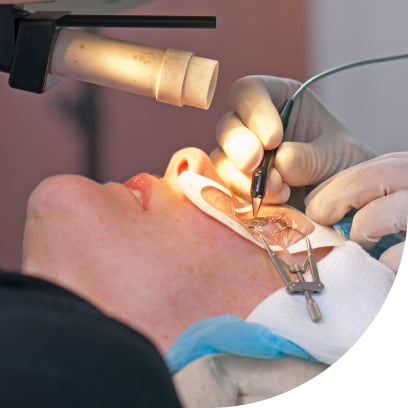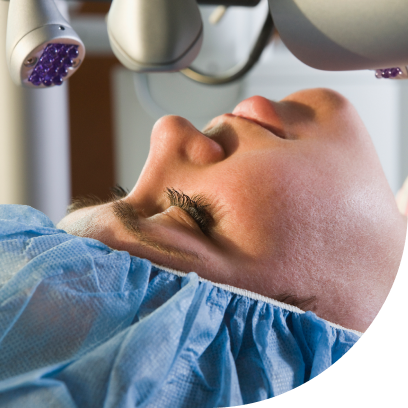
Since it’s approval for use, LASIK surgery has helped over 10 million patients, in the US alone, see more clearly! The surgery has been performed over 40 million times worldwide, and that number will continue to grow thanks to its high success rate. The history of LASIK treatment is very interesting and features many different collaborators, all with the goal of improving eyesight and bringing innovative solutions to the population. So, here’s our best answer to, “Who invented laser eye surgery?” Hint: it’s complicated.
Defining Modern Vision Correction: What Is LASIK Eye Surgery?
LASIK is a vision correction surgery that uses a laser to cut into the cornea of the patient and reshape it to fix refractive errors, such as nearsightedness, farsightedness, and astigmatism. Now, most people are aware of the unique benefits of this surgery, but it was not so long ago, 1991 to be exact, that the first LASIK procedure was performed in the US. As we trace the origins of LASIK, we’ll discover what the options were before it existed, how lasers were discovered as an option for correcting vision in patients, and the many eye surgeons and researchers that have contributed to the procedure.
The Precursor: Radial Keratotomy (RK)
The first widespread vision correction surgery in the United States was called Radial Keratotomy, and it was performed to improve nearsightedness in the 1970’s. The procedure was discovered by a Russian ophthalmologist after a young patient came in with glass lodged in his eye from his eyeglasses. The doctor noticed that when the boy’s eyes had healed, his nearsightedness had improved because of the way the glass had cut and subsequently flattened the cornea. RK, which has been largely fazed out of use due to advances in surgical procedures, consisted of the surgeon making radial cuts in the eye, similar to the spokes in a wheel. This was meant to flatten the cornea, correcting for nearsightedness. While initial results were promising, there were numerous long-term complications that made it less than ideal. However, the idea led to further innovations around the world.
The Birth of Laser Surgery: The Excimer Laser
The excimer laser was first theorized by Fritz Houtermans in 1960, and early variations were demonstrated by researchers in Moscow and at the Northrop Corporation in the early 1970’s. However, the team credited with building and using the first functional laser was from IBM in 1976, when they used it to etch organic tissue without leaving thermal damage. In 1982, ophthalmologist Steven Tokel, took this research and collaborated with one of the scientists to perform laser surgery on bovine eyes, showing that the laser could successfully reshape the cornea without causing damage. Following published research and trials, the first laser eye surgery was performed in 1987, opening the door for LASIK.
The LASIK Invention Timeline: When Did LASIK Come Out?
As you can see, inventions usually succeed because of the contributions of many different actors, not just one singular person. LASIK is no different. Dr. José Barraquer, a Colombian ophthalmologist, is often considered the father of refractive surgery. In the 1950s, he developed the concept of keratomileusis, which involved reshaping corneal tissue to correct vision, which would pave the way for LASIK. In 1989, Greek ophthalmologist Dr. Ioannis Pallikaris performed the first official LASIK procedure ever, introducing the flap technique which is still in use today. At the same time, Dr. Lucio Buratto was performing surgeries and developing similar techniques to advance the field.
Entering the Modern Era (1990s & Beyond)
The 1990s marked a turning point for LASIK as it gained momentum in the United States. The first LASIK procedure in the US was performed in 1991, but it wasn’t until 1995 that the FDA approved the excimer laser for use in photorefractive keratectomy (PRK), a precursor to LASIK. Full FDA approval for LASIK was awarded in 1999.
As word spread about the quick recovery time and impressive results, LASIK treatment became increasingly popular and accessible to the general population. Surgeons across the country began offering the procedure, and advancements in technology made it more precise and affordable. By the early 2000s, LASIK had become the gold standard for vision correction, with millions of Americans choosing to undergo the procedure each year.
Safety and Refinement: The Modern Procedure
One of the most common questions patients have today is about safety, and the history of LASIK provides reassuring answers. LASIK eye surgery complications have decreased significantly since the procedure’s early days, thanks to decades of technological refinement and surgical expertise. Modern LASIK employs bladeless techniques, wavefront-guided technology, and computerized mapping systems that create highly customized treatments for each patient’s unique eye structure, making the LASIK complication rate very low. Most patients end up achieving 20/20 vision or better. In cases where initial results need fine-tuning later, a LASIK touch up procedure can be performed.
As for LASIK requirements, ideal candidates are typically over 18 years old, have had stable vision or a stable prescription for at least a year, possess adequate corneal thickness, and have no underlying eye diseases. Today’s screening process is comprehensive and sophisticated to ensure that only qualified candidates undergo surgery.
History Backed By Excellence
What began as experimental cuts on bovine cornea has evolved into a precise, safe, and highly effective procedure that has transformed the lives of millions worldwide! At LASIK By OCLI Vision, we have a team of certified doctors who bring years of experience and expertise to every procedure, and it’s our goal to continue to build on the innovations of LASIK.
If you have a refractive error and are wondering if LASIK might be right for you, schedule a consultation at your nearest LASIK BY OCLI Vision location. Our specialists will evaluate your candidacy and discuss the modern procedure with you.
Visit our contact us page today to take the first step toward better vision backed by a rich history of surgical innovation and success.